
New ways of working have become a significant focus for organisations over the last few years. Whether it is the adoption of AI, flexible work arrangements, hybrid workplaces, or four-day work weeks, organisations continue to explore how work can be designed differently while maintaining productivity and employee wellbeing.
Among these, the four-day work week has become one of the most discussed workplace initiatives. Governments, researchers, and organisations across Australia, Europe, and other regions have explored its potential benefits, ranging from improved well-being and employee engagement to reduced burnout and increased productivity. While conversations around four-day work weeks existed before COVID-19, the workplace landscape has changed significantly since then. Employee expectations, technology, flexibility, and the way organisations measure performance have all evolved, making today’s discussions very different from those of a decade ago.
Having now experienced and helped lead the implementation of a four-day work week trial, I can understand both the excitement and the complexity that surrounds it. Like many workplace initiatives, the concept sounds straightforward on paper. In practice, however, success depends far less on reducing a working day and far more on redesigning how work gets done. One organisation I worked with chose to explore a four-day work week as part of its broader commitment to employee wellbeing and progressive workplace practices. The discussion was not solely about reducing working hours. It was also about challenging traditional assumptions around productivity, care, flexibility, and the way work is designed.
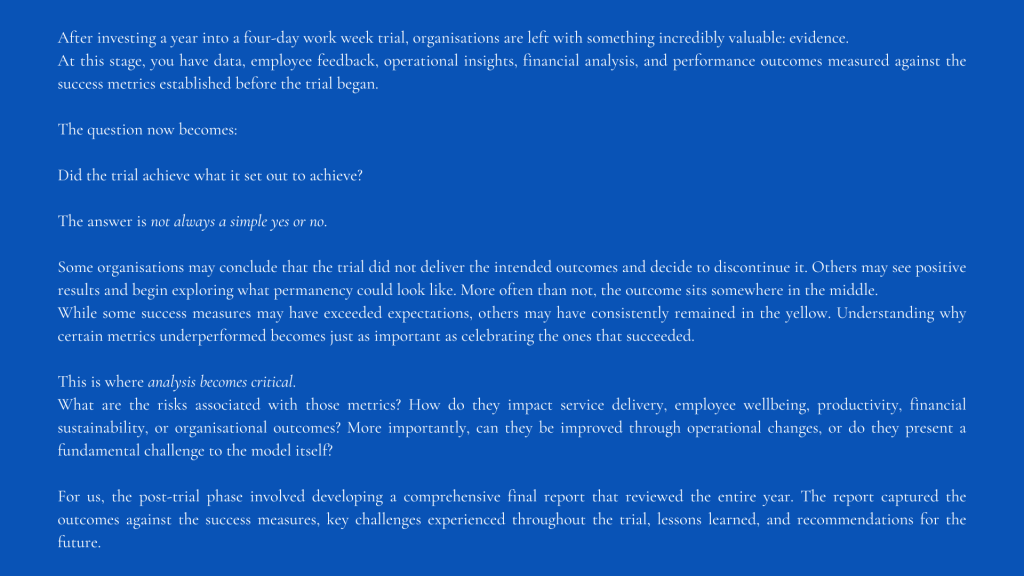
Pre-Trial
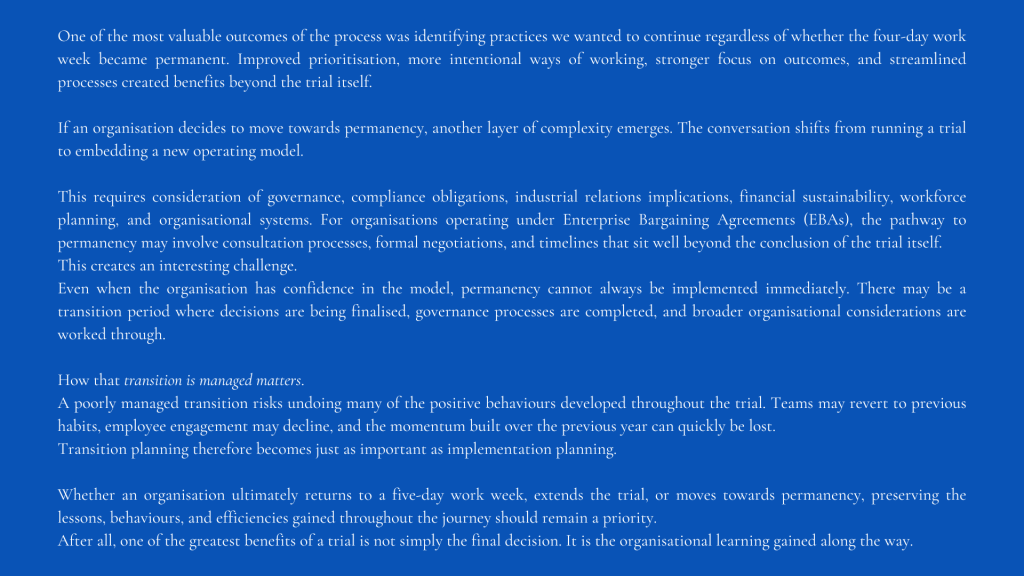
In-Trial
While much of the discussion around four-day work weeks focuses on organisational outcomes, productivity measures, and implementation frameworks, some of the most interesting learnings for me were personal.
The first was simply how valuable an additional day can be.
It is difficult to fully appreciate the impact until you experience it yourself. Having an extra day each week created space for things that would often get pushed aside during a normal work week. Whether it was personal commitments, hobbies, rest, or simply having time to slow down, I found myself returning to work feeling more recharged, focused, and present. It genuinely changed how I approached my week.
At the same time, I noticed some unintended consequences.
As teams became more focused on efficiency, some of the informal moments that naturally occur in workplaces started to disappear. Casual chats, coffee walks, spontaneous conversations, and opportunities for connection were often deprioritised in favour of task-focused interactions.
What surprised me most was that these moments did not disappear entirely; they simply became more intentional.
I found myself actively blocking time in my calendar for coffee catch-ups, relationship-building conversations, and informal team interactions. While these connections still happened, they felt less spontaneous than before. It was a useful reminder that workplace culture is often built through small interactions that can easily be overlooked when efficiency becomes the primary focus.
Another lesson was that people need time to adapt.
We often assume that giving people additional free time will automatically improve wellbeing. However, many of us have become so accustomed to busy schedules that we do not always know what to do with that time when it first becomes available.
Learning how to use the additional day meaningfully took time. Some people used it for family responsibilities, others for rest, hobbies, volunteering, or personal development. Just as organisations need time to adapt to new ways of working, employees also need time to adapt to new ways of living.
Perhaps the biggest lesson for me was that a successful four-day work week is not about squeezing five days of work into four.
Attempting to do this simply creates a different form of pressure.
The real challenge is finding more effective ways of working. It requires organisations and individuals to constantly question existing habits, challenge assumptions, eliminate low-value activities, and focus attention on what truly matters.
This is not always easy. There were moments when it felt simpler to revert to familiar ways of working rather than rethink established processes. However, maintaining focus on efficiency, prioritisation, and outcomes ultimately became one of the most valuable lessons of the entire experience.
More than anything, the trial reinforced a simple idea: the success of a four-day work week is not determined by the additional day itself. It is determined by how intentionally organisations and individuals choose to use the time they gain.

